
Showing posts with label Romanticism. Show all posts
Showing posts with label Romanticism. Show all posts
Monday, April 23, 2018
Romanticism
I think that Romanticism is still very alive today, and that the ideas of Romanticism have become ingrained in our society. For example, most of today's art is focused on self exploration and discovery, which stems from the Romantic idea that it is okay to create art about your own personal experiences. A call to return to the natural world is also still a prevalent idea in our society. The movie Avatar is a good example of modern day Romanticism because the movie is about how people should appreciate and coexist with nature, instead of destroying it. The main character finds himself as he is immersed in the natural world, and realizes how important it is for people to be connected with it. This is definitely a very Romantic theme, but with a modern addition to it- technology. In today's society, the idea of returning to the natural world has developed into a call to return to a time with less technology and more visceral interaction with the world.
The Reawakening of the National Parks System
Romanticism is a quality which can be found in architecture, art, music, and poetry. And although the climax of the romantic movement was during the 18th and 19th century there are re-occurrence of the movement's fervor and beauty in various aspects of modern culture. One prime example of this fervor is the centennial of the national park system.
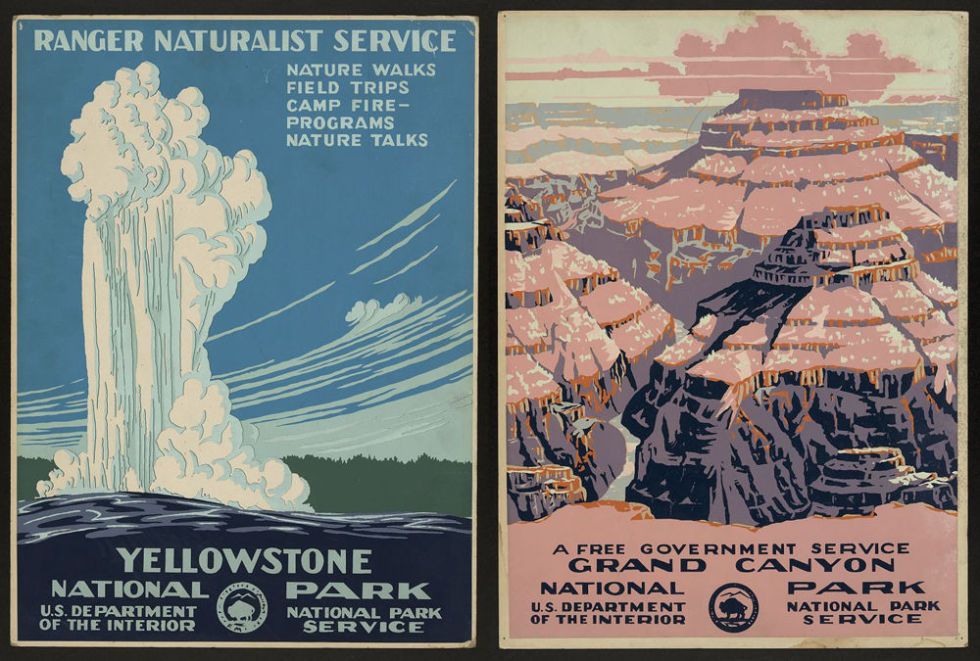
In 2016 the national park system experienced its centennial, and they advertised it. Special programs took place at each of the parks and "limited addition" national park gear was available at most outdoor recreation stores. These forms of advertisement accounted for a large part of the revival of interest in both the national parks and nature in general. However, I believe the aspect of the centennial which had the greatest impact on the American public was the old WPA (Works Projects Administration) posters from the great depression era shown below.
The romantic movement is all about finding beauty in the simplicity of nature, which is exactly what the WPA posters accomplish. The posters are minimal, using only 3 or 4 colors, yet stunning as they depict some of the grandest vistas of North America. The fact that these posters were such a huge hit during the centennial of the NPS demonstrates how romantic modern society continues to be. Additionally from 2015 to 2016 the number of annual visitors increased by nearly 30,000 people, roughly twice the average growth rate for our national parks (www.nps.gov). This statistic further demonstrates how much a romantic movement, such as the reuse of WPA posters impacts individuals and encourages the American public to return to nature.
In 2016 the national park system experienced its centennial, and they advertised it. Special programs took place at each of the parks and "limited addition" national park gear was available at most outdoor recreation stores. These forms of advertisement accounted for a large part of the revival of interest in both the national parks and nature in general. However, I believe the aspect of the centennial which had the greatest impact on the American public was the old WPA (Works Projects Administration) posters from the great depression era shown below.
The romantic movement is all about finding beauty in the simplicity of nature, which is exactly what the WPA posters accomplish. The posters are minimal, using only 3 or 4 colors, yet stunning as they depict some of the grandest vistas of North America. The fact that these posters were such a huge hit during the centennial of the NPS demonstrates how romantic modern society continues to be. Additionally from 2015 to 2016 the number of annual visitors increased by nearly 30,000 people, roughly twice the average growth rate for our national parks (www.nps.gov). This statistic further demonstrates how much a romantic movement, such as the reuse of WPA posters impacts individuals and encourages the American public to return to nature.
Saturday, April 21, 2018
The Magic in Romanticism
Qualities and traits of romanticism from the 17th and 18th century such as a deepened appreciation of the beauty of nature, general preference of emotion over reason and the importance of sense over intellect is still strong in American culture today. The romantics preoccupation with the genius, the hero and the exceptional figures in general, while focusing on inner struggles can be found in many aspects of today’s pop culture. A focus on the individual and imagination that is at the center of the romantic movement, is a prevalent trait in many artistic works today.
In the Harry Potter Series, we see many examples of heroism and genius and individuals struggling to come to terms with their inner selves. Harry himself, split at birth by the wicked spell of “He That Shall Not Be Named” is full of wonder and amazement as he attempts to patch the tear within. Ordinary kids turned super-heroes, Harry, Ron and Hermione fight the depths of darkness using emotions and a heightened sense of what could be to guide them. The series has so many characters that stretch our imagination and continually manage to go beyond the ordinary. There is no shortage of natural beauty in Harry Potter both as described in the books and as shown in the movies on the big screen. Even though the story is about a group of kids and adults marching towards a final showdown as a group against evil - it is very clear along the way that the main characters are very strong individuals that are continually forced to look within and overcome significant doubts.
The focus on emotion, personal growth and super heroes is a main theme in the Harry Potter series making it a pop romantic classic. The genius of Dumbledore throughout the series and Harry’s transcendence of death that occurs in the final chapters are examples of Romanticism. The popularity of the series speaks to a hunger in today’s society for heroism and a power that can outwit evil and darkness. In the end, we all want to see Harry and friends prevail and find peace and happiness after their long journey to be free to live their lives without the darkness of Voldemort and his followers.
In the Harry Potter Series, we see many examples of heroism and genius and individuals struggling to come to terms with their inner selves. Harry himself, split at birth by the wicked spell of “He That Shall Not Be Named” is full of wonder and amazement as he attempts to patch the tear within. Ordinary kids turned super-heroes, Harry, Ron and Hermione fight the depths of darkness using emotions and a heightened sense of what could be to guide them. The series has so many characters that stretch our imagination and continually manage to go beyond the ordinary. There is no shortage of natural beauty in Harry Potter both as described in the books and as shown in the movies on the big screen. Even though the story is about a group of kids and adults marching towards a final showdown as a group against evil - it is very clear along the way that the main characters are very strong individuals that are continually forced to look within and overcome significant doubts.
The focus on emotion, personal growth and super heroes is a main theme in the Harry Potter series making it a pop romantic classic. The genius of Dumbledore throughout the series and Harry’s transcendence of death that occurs in the final chapters are examples of Romanticism. The popularity of the series speaks to a hunger in today’s society for heroism and a power that can outwit evil and darkness. In the end, we all want to see Harry and friends prevail and find peace and happiness after their long journey to be free to live their lives without the darkness of Voldemort and his followers.
Friday, April 20, 2018
An Endless Romantic Opportunity
What is romanticism? To boil things down a little, romanticism is a style and mindset that seeks to celebrate emotion, individuality, and rejects established ideals and systems for nature and its guidance.
Romantic artists would look almost solely to nature as their muse, finding that they are able to find the most beauty and individuality with the trees, grass, breeze, flowers, and sun. Why was this? Would they feel the same way today? Much of the romantic movement was focused on moving away from the way society existed as it was, returning to a natural perspective, free from judgement, able to live the way one saw fit. Nature was infinite beauty, and once entered, no one told you who to be or how to do what you liked except yourself. Romantic writers would take this idea and run with it, escaping from many of the previous writing conventions for poetry, even believing that their writing would change the world. Their movement evokes freedom at its core. Uninhibited freedom.
So what else do we know that is nearly infinite, allows for strong emotion, individuality, free thinking, and change? If it takes you more than like five seconds to come up with the answer I have in mind, let me ask what you're reading this post on. The internet. Beautiful, dangerous, ugly, safe, and unimaginably vast. The internet itself embodies humanity. It is a record of the collective consciousness of our entire species. Even those who are not directly online are reflected in one way or another. This echo chamber that we love so much is the new romantic landscape. Introspection and individuality come rising to the top for people as soon as they hit social media. Anonymity lets people be themselves, regardless of how ugly or beautiful that self may be. People can try to tell others how to be or what they should do, but all one has to do is look the other way. Romantic artists were judged for sure. People who chose to live in the woods all day and write long winded poetry for a living are going to get looked at funny. They chose to look away and stay true to themselves and carry on. The same goes online. Even those who do cave to peer pressure can learn a ton about themselves and further understand who they are and how they fit into the landscape of the universe. What about nature itself? The trees, the sun, the rain, and the flowers? Just google it. Just typing in nature is more than enough to conjure images of decades of travel. While it may only appeal to sight, and maybe sound if you watch a video, nature can be largely captured still. If you need the complete experience, congratulations, the internet will follow along in your pocket.
The internet is the second coming of nature. Our second teacher who just learns more and more, and learns to teach even better about ourselves. Hunching over our cell phones in our own little bubbles may seem closed off, but what is a screen other than a window to the knowledge and experiences of centuries of people? So is romanticism dead? What would the old romantics think of today? For some final context, the romantic movement took place before humans even had radios. Television did not exist. People were limited to the thoughts and ideas of those immediately surrounding them. If you did not fit in there, you were alone. There really weren't many other people, and it would be hard to see other perspectives like we can today. How would people not look to free themselves from that kind of system? I think romantics would find the internet just as liberating as we do, even with all of the problems it brings.
Thursday, April 19, 2018
Sci-fi or Romanticism?
Many people may think that Romanticism was a thing of the past, only a small time period. However, Romanticism can be seen everywhere today. Even in science-fiction, which is one of the last things you might think of as Romantic. Sci-fi demands the watcher/reader's imagination as it twists their perception of the world. Reason would dictate that much of what occurs in sci-fi is impossible, but you automatically want to believe it is real; it triggers your imagination. In addition, by defying the natural laws, it displays the importance of nature when we notice it is missing. It draws our attention to what is missing, and the smallest parts of nature suddenly play an obvious major role. It also plays a similar role in contrasting from everyday life, allowing us appreciation of the simple parts of life we suddenly find are missing.
Strong emotion also plays an obvious role in sci-fi. Any media is not enjoyable or worthwhile unless it evokes strong emotion. Sci-fi can evoke a whole range of emotions, from fear to anger, or excitement and joy. It also articulates one individual perspective, generally a human facing an unnatural problem. This allows the reader/watcher to connect it to their own (hopefully less extreme) problems in everyday life.
Strong emotion also plays an obvious role in sci-fi. Any media is not enjoyable or worthwhile unless it evokes strong emotion. Sci-fi can evoke a whole range of emotions, from fear to anger, or excitement and joy. It also articulates one individual perspective, generally a human facing an unnatural problem. This allows the reader/watcher to connect it to their own (hopefully less extreme) problems in everyday life.
The Hypocrisy of This Assignment
I'm not trying to call anyone out, but its about time for another rant about the problems clearly apparent in the structure of the American education system.
I think there is hypocrisy in this assignment in that we are analyzing romantic poems that are telling us to stop analyzing them and go experience the world around us firsthand. Not that education is not important, it very much is. But if indoor, logical, one perspective analysis is all we do, we are not taking advantage of the opportunities presented to us by the world by simply existing in it.
Romanticism is all about praising nature and questioning the normalcy of typical societal expectations. Yet we follow a schedule every day in school or work that encourages if not forces us to cling to rigidity. I think this is a reason why we find there is a significant gap between our ability to learn the technical aspects of a subject versus our ability to apply them in the real world. And, if we're being honest, education is mainly here to prepare us for the "real world", and to equip us with the understanding of the world so that we can better it. But if we remain locked away from the world, how are we to change it?
Yes, reading and analyzing poetry has its benefits and importance. Most things do. But it would be irresponsible of us as analysts to not consider the opposite perspective.
I think there is hypocrisy in this assignment in that we are analyzing romantic poems that are telling us to stop analyzing them and go experience the world around us firsthand. Not that education is not important, it very much is. But if indoor, logical, one perspective analysis is all we do, we are not taking advantage of the opportunities presented to us by the world by simply existing in it.
Romanticism is all about praising nature and questioning the normalcy of typical societal expectations. Yet we follow a schedule every day in school or work that encourages if not forces us to cling to rigidity. I think this is a reason why we find there is a significant gap between our ability to learn the technical aspects of a subject versus our ability to apply them in the real world. And, if we're being honest, education is mainly here to prepare us for the "real world", and to equip us with the understanding of the world so that we can better it. But if we remain locked away from the world, how are we to change it?
Yes, reading and analyzing poetry has its benefits and importance. Most things do. But it would be irresponsible of us as analysts to not consider the opposite perspective.
Rororomanticism Gently Down The Stream
When I think of the lasting effect of Romanticism I think of my right to have a personal, private and individualistic approach to viewing art. The movement not only values individual’s inner impulses to create art but also one’s reactions to the art and that’s what I love so much about it.
I would not consider myself an artist therefore I experience art as a witness. I think this movement validates emotional attachment to art, which is one of my greatest weaknesses. I find myself going back to the same paintings at art museums over and over again, printing out poetry and putting it on my walls. I sometimes even tape printed out song lyrics on the walls of my shower so I can practice for when I’m singing in my head with my earphones in. It has gotten to the point where I´ll get attached to pretty looking trash I find on the street and then carry it around in my pockets for weeks. I think Romanticism encourages befriending yourself, discovering quirks and validating your own experience as you live it.
I feel like there is so much in life where the end goal is to learn something or better yourself in some noticeable way but the way Romantics define art allows us to be more meditative and mindful and introspective.
This might be too meta: maybe I am getting overly Romantic and misinterpreting the movement but... isn’t it all about subjectivity?
I feel like there is so much in life where the end goal is to learn something or better yourself in some noticeable way but the way Romantics define art allows us to be more meditative and mindful and introspective.
This might be too meta: maybe I am getting overly Romantic and misinterpreting the movement but... isn’t it all about subjectivity?
Romanticism
Recently, I have discovered a love for walking in nature. The serenity that nature offers is unparalleled. I can identity with the poets of the Romanticism era because I, too, understand how they sought their escape and self-expression through nature. When I am surrounded by nature, I feel content to the point where my worries are gotten. It is easy for individualism to thrive when one is surrounded by solely nature because there are less pressures present than in the unnatural world. Similarly, simply being around nature conveys a vibe of naturalness, purity, and solidarity. A couple weeks ago, my friend and I visited our college campus and made a stop at the state park nearby. It was a cooler day when we went, and there was a dusting of snow as well as more coming down. We spent hours observing and soaking up the ambiance the park had to offer. Almost immediately as I entered, I felt a different vibe. Being surrounded by towering, beautiful trees is hard to acutely describe, but it definitely inspires romanticism.
Is Romanticism shaping our culture from beyond the grave?
I think that Romanticism certainly died as an artistic movement, but in its decomposed state it continues to shape popular culture. Though at the time Romantic ideas seemed revolutionary, our society has gradually internalized them. Today, we simply take them for granted, as conventional wisdom or as a set of rules that define mainstream art.
This influence is most obvious in popular music, regardless of genre. Our culture values artists who authentically and emotionally communicate personal experiences, an approach first popularized by the Romantics. Oftentimes, we also value passion and spontaneity over craftsmanship and perfection. For example, Migos recently admitted that they spend an average of 20-40 minutes on their songs, while Lil B, one of my favorite rappers, is notorious for releasing mixtapes composed of dozens of directly freestyled tracks. A similar trend exists in contemporary visual art, where many famous artists, beginning with the likes of Jackson Pollock, value process over the final result.
Nature might not be as dominant in today’s poetry and art as it was in the times of Romanticism, but I don’t think that it’s a defining element of the movement. It seems to often serve as a metaphor for the individual mind and spirituality, rather than a subject in and of itself. I think that popular contemporary artists and writers simply learned to be more direct about these subjects, so they don’t project onto nature as much. Other specific details of Romanticism though, like its fascination with dreams and drugs, seem even more prevalent in modern culture. So although Romanticism lost much of its acuteness, I would say that it continues to frame our art and culture to this day.
This influence is most obvious in popular music, regardless of genre. Our culture values artists who authentically and emotionally communicate personal experiences, an approach first popularized by the Romantics. Oftentimes, we also value passion and spontaneity over craftsmanship and perfection. For example, Migos recently admitted that they spend an average of 20-40 minutes on their songs, while Lil B, one of my favorite rappers, is notorious for releasing mixtapes composed of dozens of directly freestyled tracks. A similar trend exists in contemporary visual art, where many famous artists, beginning with the likes of Jackson Pollock, value process over the final result.
Nature might not be as dominant in today’s poetry and art as it was in the times of Romanticism, but I don’t think that it’s a defining element of the movement. It seems to often serve as a metaphor for the individual mind and spirituality, rather than a subject in and of itself. I think that popular contemporary artists and writers simply learned to be more direct about these subjects, so they don’t project onto nature as much. Other specific details of Romanticism though, like its fascination with dreams and drugs, seem even more prevalent in modern culture. So although Romanticism lost much of its acuteness, I would say that it continues to frame our art and culture to this day.
Romanticism in today's society
Most people think romanticism is all about love and marriage. However, romanticism is actually a movement that involves our immersion in nature and beauty in the world around us. Is romanticism alive today? I honestly don't think it is because everyone has forgotten the basic principles behind it. Everything with technology has made the world lose connection with reality. They are all stuck in a bubble that just revolves around what the world with technology sees. Also, with all the new technology nowadays it makes it hard to actually see romanticism in today's society. With people being on their phones all day and not realizing what is around them; they forget the true meaning of beauty and nature. In today's society, all anyone cares about is how many likes a post gets, how many followers they have, all of their snap chat streaks, etc. What everyone sees online is different from the real perspective of beauty and nature so no one knows the right definition of romanticism. Technology stops us from trying to explore more of nature and beauty and the imagination of it all.
Romanticism
I do not think that Romanticism is alive today due to social media, our system of education and our cultural norms of finding entertainment in technology, lacking appreciation for nature, and learning by thinking and theorizing rather than doing (like Walt Whitman suggests in his poem about astronomy and looking at the stars).
I think that relative to most people I am a romantic because I try to use very little social media and I try not to follow the crowd, but I do not think it is possible to truly be a romantic, nor do I think it is something to strive for. Being a romantic means being more connected to nature and idealism than it does to other people and reality. I think that people could use a bit of romantic energy to break from society's more unromantic ideals (listed above), but our society is already overly individualistic, like many Western cultures, favoring the individual over the family or the group, emphasizing the "bootstraps" ethic etc. Therefore, I do not think it is hypocritical to be taught romanticism in a classroom because some of its components can be effectively embraced without completely denying your current lifestyle. Romanticism seems ideal in theory, but if everyone acted all the time instead of thought, or never connected with the people around them, the world could become an immoral, lonely place.
Wednesday, April 18, 2018
A Romantic?!?! Yes!
Personally, I do believe that I am a bit of a romantic. I believe in Utopian social change and do think the world can be a better place if we make it that way. I don’t believe everyone is is equal, has equal opportunities, and that the world is fair and perfect. However, I do believe in Utopian social change and that one day the world or at least the United States can be organized in a way to serve the needs and aspirations of ordinary people. Perhaps by getting more ordinary people in positions in power or more people that represent ordinary people. All people would have equal access and opportunity to materials necessary to prosper. People would have a greater access and more of a say in the decisions about things that affect their lives. Finally, future generations need to have sustainable earth so they can thrive at the same level we are able to.
Romanticism is also still alive to day in our world it is seen in our art, music, and film.
This piece of street art reflects the importance of nature and individuality (freedom from tradition/ social conventions). It seems to emphasize the importance of returning to nature or that no matter how much we industrialize and try and move away from nature it will always be inside of us.. An example of a music piece that is romantic is Avicii: Wake me Up. Avicii establishes individualism by expressing his desire to escape from social norms within the song. In Lady Gaga’s, Born This Way, individuality is also expressed. The lyrics celebrate the beauty of difference and unique qualities in each of us.
A big part of the generation today is escaping and breaking social norms and creating new ones. Many people of this generation have strong emotions and let the power of their imagination allow them to dream big and whatever they want. This can be heard in Royals by Lorde. She creates this Utopian world within her song and states that even if the Utopian world doesn’t happen we can “drive Cadillac in our dreams”(power of imagination). Avatar is another example of romanticism. It has the inspiration of nature, strong emotions, Utopian social change, and freedom from societal norms.
Tuesday, April 17, 2018
Romantic technology
Romanticism slowly seems to be diminishing due to technology. Social media has caused more conformity than ever. How can I get more likes? Who do I aspire to make myself out to be online? There is a huge disconnect now from reality to the internet. Working at an ice cream parlor I see serious faced customers examine all the choices, complain about the price, then pose for an excited selfie next to their sprinkle topped cookie dough waffle cone. After posing for a selfie, many sit with their friends or family outside then all immediately take out their phones to see what others are doing. Why look at what others are doing when you are outside with people you love eating ice cream? Why take away from your own individual experience, and remove yourself from the happiness that comes with ice cream, friendship, and warm weather, to mindlessly scroll through the faces of people you may talk to once a week or less?
Personally I work two jobs, I train at the gym every morning, and try to run outside or bike everyday after school, and for longer on the weekends. I never bring my phone with me on my runs to completely embrace myself in nature, and to connect my body and my breath with my movements. Nature and personal experiences in nature have become my own form of meditation and joy. I always strive to do what makes me happy, and for the most part it differs greatly from the people around me. From going on 100 mile bike rides with no music along the lake, to wearing "hammer-pants" I found at Salvation Army for $2 to school, I truly believe I have established myself as an individual. Though I do catch myself scrolling through Instagram and Facebook, I try to limit myself. I like to think that wherever I am, and whatever I am doing with myself, my friends, or my family is more interesting, or important than anything I could watch from the screen in my pocket.
Personally I work two jobs, I train at the gym every morning, and try to run outside or bike everyday after school, and for longer on the weekends. I never bring my phone with me on my runs to completely embrace myself in nature, and to connect my body and my breath with my movements. Nature and personal experiences in nature have become my own form of meditation and joy. I always strive to do what makes me happy, and for the most part it differs greatly from the people around me. From going on 100 mile bike rides with no music along the lake, to wearing "hammer-pants" I found at Salvation Army for $2 to school, I truly believe I have established myself as an individual. Though I do catch myself scrolling through Instagram and Facebook, I try to limit myself. I like to think that wherever I am, and whatever I am doing with myself, my friends, or my family is more interesting, or important than anything I could watch from the screen in my pocket.
Monday, April 16, 2018
Pitfalls and Pickups
Much like other artistic movements, Romanticism has perpetuated and held questionable themes, all the while producing renowned work. A common theme throughout English Romanticism is to fetishize and generalize cultures in order to create a natural world virtually untouchable to Westerners. This odd dichotomy of appreciating the natural world whilst tearing down its originality in order to fit into a Westernized lens has been brought to light more and more as Romanticism is studied.
I feel through my own observations some aspects of Romanticism, specifically in regards to the glorification of the natural world, are still present today in a harmful manner. However, I also find this same rebellion against industrialization in a way that is more expansive and renovated to modern day standards.
The foundational usage of the natural world and its conservation in Romanticism can be influential if done in a manner that truly appreciates something for what it is, and leaves out the generalizations and stereotypes of people. Preaching an appreciation for our surroundings, and its seemingly out worldly mechanisms can be done without harmfully boxing in groups of people. I feel our generation could use some appreciation for the resources many of us still have today, and hopefully this appreciation would prompt conservation as well.
I feel through my own observations some aspects of Romanticism, specifically in regards to the glorification of the natural world, are still present today in a harmful manner. However, I also find this same rebellion against industrialization in a way that is more expansive and renovated to modern day standards.
The foundational usage of the natural world and its conservation in Romanticism can be influential if done in a manner that truly appreciates something for what it is, and leaves out the generalizations and stereotypes of people. Preaching an appreciation for our surroundings, and its seemingly out worldly mechanisms can be done without harmfully boxing in groups of people. I feel our generation could use some appreciation for the resources many of us still have today, and hopefully this appreciation would prompt conservation as well.
Millennials and Romanticism
When the word Millennial comes to mind, what characteristics do you think of? Lots of people would say lazy, needy, or entitled. Three weeks ago, I would probably have echoed my parents and their friends by saying something along the same lines as that. However, after being enlightened by the meaning of true Romanticism, I don't think there is a better fitting description for what a Millennial is, other than a Romantic.
Millennials are scrutinized for traveling too much, instagramming too much, and making eye contact too little. On the surface it would appear that yes, they are all those things and more. Yet, viewing Millennials with a romantic lens, it is easy to see that these young adults aren't trying to slack off on their work. Rather, they are people trying to soak in the fruit of life, experience simple things, and not get trapped in a 9-5 job for their entire lives.
I've started to wonder why older generations look down on Millennials so much. It may be because Millennials have been able to do what Walt Whitman and Emily Dickinson encouraged while young, but much of our older generations haven't been able to "dance with the daffodils" until retirement or even not at all. Perhaps if people young, old and in between spent more time appreciating what was around them rather than what they need to get done or where they need to rush to, the Millennials generation could be more understood.
Personally, I feel that even as member of Gen Z, I am a bit of a Romantic. I try to appreciate the natural environment around me, and in the future I also want to protect it both so that I can breathe, but also so that the generations to come will be able to experience the true beauty of big oak trees, falling leaves, and a sandy beach near an ocean. I hope that as I continue to learn, I, along with my peers, will grow into true romantics, and create a more simplistic, equal future.
My Own Version of a Romantic Poem
My intentions aren’t to fill you with the leaves of Whitman.
But if I had to compare you to one thing,
It would be along the lines of the seasons.
Summer is far too temperate to sum you up,
And autumn too flimsy and crinkly.
Maybe right between winter and spring.
That kind of time where
You’re not so sure if you’ll be chilled and brittle,
Not so sure if you’ll be reborn and baptized in warm beams
That saturate you only to the brink of sweat.
I’d never met someone who could simultaneously
Make me quiver and tremble at the idea of safety.
Or make me so insecure a drizzle of perspiration was always there,
Reminding me I was one of many who were feeling the same thing.
Cause I don’t believe in that drenching,
Heart hugging kind of love.
I think people are gonna leave you when you’re least ready to let ‘em go.
And no altering season is is gonna change that hovering, cloudy thought.
Don’t you recall that night,
When the moon sent down sharp teeth onto the earth,
And swallowed everything we knew about the inky black parts of night?
You told me everything was okay with us.
I wished day would come and materialize the truthful syllables under your tongue.
But the funny thing about affection is,
It falls right when you think it’s rising.
Thursday, April 12, 2018
Romantic Medicine
So a doctor, whose writings I follow, just posted on his own blog about "Health Care for the Romantic," discussing how "alternative Romantics," both doctors and patients, might have something to offer the medical "authorities."
Just to be clear, I am not endorsing any particular approach to healthcare here. I'm just fascinated about how the Romantic perspective is still alive today.
Just to be clear, I am not endorsing any particular approach to healthcare here. I'm just fascinated about how the Romantic perspective is still alive today.
Wednesday, April 11, 2018
Romanticism in Individual versus American Identity
Within my own life, some vital aspects of Romanticism help me find fulfillment. Witnessing the simple joys of changing weather and seasons makes me feel inspired and appreciative of where I live; observing and participating in people's actions to promote a more inclusive world makes me hopeful for future generations. In these ways, I find that the Romantic philosophy of honoring emotion and passion continues to have a positive effect on my personal growth, promoting the development of my own identity.
As Romanticism becomes entangled with a larger 'American' identity as opposed to an individual one, the situation becomes more complex. When I first read segments of Walt Whitman's preface to Leaves of Grass, I could not understand how the renowned poet could both argue for the self-actualization of the common people while also stating that English is the 'dialect of common sense.' How can someone who fights for the liberation of 'all' simultaneously emphasize the superiority of some (in this case, English speakers)? Within the context of American history, it makes perfect sense. As an American, I'm realizing it's all too easy to fall into the Romantic trap that characterizes this nation. Nothing is more traditionally American than utilizing the 'radical' rhetoric of individual freedom in order to justify exclusion and superiority.
Is the Romantic voice that seeks to abandon society and go back to a simpler, more natural life not the same voice arguing for stripping back modern protections for marginalized groups in order to return to 'traditional values' in 2018? After all, each of these concepts centers on the notion of leaving modern changes in favor for 'better times.' This nostalgic past proves to be elusive and difficult to define. For whom did the past grant a greater sense of 'freedom?'
Ultimately, I feel as though the beautiful, salvageable aspects of Romanticism --the deep love for oneself and others, the appreciation of an environment--are too often overshadowed by the frame of American exceptionalism. In 2018, it's more crucial than ever to understand and question how Romanticism exists in the mouths of those in power and the minds of every citizen in order to promote the better aspects of this movement for a less prejudiced future.
Loss of Traditional Meaning and Why that is OK
Romanticism is alive and well, dead (too). At least, in the traditional sense of the movement that delves into the philosophical and distinctly characterized nature of the term, its modern iteration is much less (traditionally) ¨thoughtful¨ as it is (modernly) ¨provoking¨ candy to the mind´s eye. Traditional Romanticism is very much rooted in individual and the emotional catharsis of the individual, almost always in the context or presence of the natural world. This is the basis for the poems and artistic expression that defined the era in American history, and while not what characterizes Romanticism in the present day, it's unfair to say that deviation or adaptation of its meaning to a changing world is a loss of its values entirely.
Modern romanticism is much less thoughtful than its original form but that is not to say it is any less endearing or ¨valid¨. It may be true that in such a modern world of easily accessed distractions, one doesn't take time to admire the morning lilys that clings to the yard fence, but they receive their dose of the romantic by other means. As the pen and paper are to the 19th century American be the tablet and big screen to the modern one; our sense of the romantic is displayed to us on the big screen. It's seeing long panning shots of a Hawaiin sunset against the admiring waves below that reflect it respectfully that stirs something within us. The entice of seeing the main hero and heroine kissing under a jeweled sky and kindly obtuse moon that warms us as much as the loving projection of emotion before us. It's those moments that flutter the heart with some sense of longing; something that fills with a sense of profound love and reciprocation to the natural world's fruitfulness; it is something that fills us with a sense of nostalgia for something we perhaps never had. It is my belief that this same flutter of the heart, no, of the inner self, that resonates in tune of some provocative and warming display of humanity, nature, and the longing to experience that is the same expression that Transcendental America inspired in the hearts of those in the 19th century.
Are we less creative, more narrow-minded if our sense of wonder and freedom with the natural world is spoon fed to us? I do not think so. Adaptability and individual applicability is something that even the most conservative of Romantics would say is a crucial characteristic of the movement. Romanticism is meant to grasp the reader, the artist, the poet, with the enlightenment of its expression. If we cannot but be shown it on the big screen or television, then so let the romantic spirit live on changing, adapting, and provoking the hearts of those who embrace it.
Modern romanticism is much less thoughtful than its original form but that is not to say it is any less endearing or ¨valid¨. It may be true that in such a modern world of easily accessed distractions, one doesn't take time to admire the morning lilys that clings to the yard fence, but they receive their dose of the romantic by other means. As the pen and paper are to the 19th century American be the tablet and big screen to the modern one; our sense of the romantic is displayed to us on the big screen. It's seeing long panning shots of a Hawaiin sunset against the admiring waves below that reflect it respectfully that stirs something within us. The entice of seeing the main hero and heroine kissing under a jeweled sky and kindly obtuse moon that warms us as much as the loving projection of emotion before us. It's those moments that flutter the heart with some sense of longing; something that fills with a sense of profound love and reciprocation to the natural world's fruitfulness; it is something that fills us with a sense of nostalgia for something we perhaps never had. It is my belief that this same flutter of the heart, no, of the inner self, that resonates in tune of some provocative and warming display of humanity, nature, and the longing to experience that is the same expression that Transcendental America inspired in the hearts of those in the 19th century.
Are we less creative, more narrow-minded if our sense of wonder and freedom with the natural world is spoon fed to us? I do not think so. Adaptability and individual applicability is something that even the most conservative of Romantics would say is a crucial characteristic of the movement. Romanticism is meant to grasp the reader, the artist, the poet, with the enlightenment of its expression. If we cannot but be shown it on the big screen or television, then so let the romantic spirit live on changing, adapting, and provoking the hearts of those who embrace it.
More Than a Sitcom?
The romantic qualities of The Office go beyond Jim and Pam’s office flirtation and eventually love. When the traits of romantic works were taught to us from Mr. Heidkamp’s powerpoint, The Office was on my mind, from watching an episode the night before. But, when I thought about it more, I think The Office can qualify as a romantic work, because it is in line with quite a few of the characteristics of such work.
The whole premise of the series is to show a “microcosm of American life” through the daily filming of a seemingly mundane paper supply company. The employee of Dunder Mifflin are filmed candidly throughout their workdays, as well as interviewed one on one. And while this show is of course fiction, the focus on everyday life and the experience of an average person is a romantic aspect of the show. The Office also provides an emphasis on the individual’s experience. By, say, interviewing Pam after an exchange with Jim or interviewing Andy to get his opinion on something Dwight did, they are emphasizing the importance of individualism. I understand that they include these bits because whatever Stanley has to say about something totally ridiculous that Michael did is always funny. But, the fact that viewers know that Stanley would have his funny, fed up take on something, Dwight would have his too literal take on something, and Andy would have his annoying take on something, and the viewer could be able to clearly know all of them, highlights the emphasis The Office places on the individual. The Office is a televised example of the appreciation of individuals and of everyday life and language, which is something that I think would’ve made Walt Whitman or William Wordsworth a fan of it.
The Office also, to an extent, gives the reader an experience of freedom from tradition and social conventions, largely through Michael Scott. Michael has a very non-traditional way of running the Scranton branch of Dunder Mifflin. Michael’s imagination often also takes full control over empirical reasoning. Examples of this can be seen during episodes like the beach day, where he made the employees compete in camp games to see who would be the be candidate for his possible replacement. Michael’s unconventional office structure could be seen as a tribute to romanticism through the freedom from tradition and heavy reliance on the imagination that takes place. I understand The Office was made, and then remade, to be a light, funny sitcom, but if you take a step back, I think a lot of romantic qualities are hiding in the show.
The Office also, to an extent, gives the reader an experience of freedom from tradition and social conventions, largely through Michael Scott. Michael has a very non-traditional way of running the Scranton branch of Dunder Mifflin. Michael’s imagination often also takes full control over empirical reasoning. Examples of this can be seen during episodes like the beach day, where he made the employees compete in camp games to see who would be the be candidate for his possible replacement. Michael’s unconventional office structure could be seen as a tribute to romanticism through the freedom from tradition and heavy reliance on the imagination that takes place. I understand The Office was made, and then remade, to be a light, funny sitcom, but if you take a step back, I think a lot of romantic qualities are hiding in the show.
Subscribe to:
Posts (Atom)