Showing posts with label irony. Show all posts

Sunday, February 24, 2019

There's a Tiger in the Bathroom!

The Hangover, at its core, is the story of a bachelor party in Las Vegas. The movie starts near the end, with a seeming disaster. The group has lost the groom and the lavish outdoor California wedding, scheduled to take place in five hours looks like it won’t be happening.

At this point the movie goes backward in time to the beginning of the story. At first, it seems pretty standard. A group of privileged white guys in their late twenties plan a bachelor party in Vegas. They take the groom’s future father in laws luxury convertible Mercedes and hit the road. The audience expects to see excessive alcohol consumption, some gambling, strippers and bad behavior. However, the movie is a clever comedy.

After arriving in Vegas, the four men toast on the roof of the hotel to ¨a night they will never forget¨. The toast is a clever use of irony, because the men have a night that they will never forget because it is a night they do not remember. When they wake up the next morning, their hotel room is completely trashed, the groom is missing and no one can remember anything. The writer uses hyperbole to communicate the completely outrageous nature of what has taken place. In addition alcohol and broken furniture everywhere, there is a rooster in the room, a tiger in the bathroom, a baby in the closet and possibly the best use of irony, Stu, the dentist, has lost one of his incisors.

Friday, February 22, 2019

President Barbie

In this SNL skit, "President Barbie", the little girls who are being convinced to buy the barbie doll are completed uninterested in the item. The ad speaker tries to persuade them that the barbie doll is a great toy to play with because it's a female just like them and on top of that, it's a presidential barbie.

This scene is a perfect example of situational irony. When you first watch the video, you expect for the girls to fall in love with the female doll, especially one that's in a presidential position. Instead, it's the exact opposite. They decide not to play with dolls and play with their other toys such as legos.
The skit makes fun of the little girls and their way of thinking. The idea of the doll is ultimately to try to change the way people think of women in general I guess by making a doll that's in a high position.

Satire: The Simpsons

The Simpsons series, created by Matt Groening and the show focuses on satirizing the modern day American family. In this episode, originally from 2008 during the 2008 Presidential Election between John McCain and President Obama. Homer goes to the voting booth in an attempt to vote for President Obama, however, the machine malfunctions and counts the vote for McCain instead. As Homer realizes that machine is rigged, it suddenly sucks him in and harms Homer in the process. Homer tumbles out of the machine, unconscious and a man sticks an "I voted" sticker on his forehead.


I think that the clip is satirizing the idea that the American electronic voting machines are rigged or flaws in the overall voting process.

There are multiple techniques used within the short clip to help convey the message:
  1. A parody was used to make fun of the voting machines in Ohio during the 2008 Presidential Election when the machines mysteriously switched votes from President Obama to John McCain. 
  2. Verbal irony is used when Homer says "I would like to vote for President, Governor, or anything else that will take money away from our parks and libraries" (The irony is that voting for someone is supposed to bring positive changes not negative ones). 
  3. Once again verbal irony/incongruity is used when Homer says "This doesn't happen in America! Maybe Ohio, but not in America!" (Ohio is in America!)
I think that this clip overall is an effective use of satire because it emphasized concerns that the American people had our voting system by using the Ohio incident as an example. In fact, people today still have the same concerns regarding electronic voting systems today as they did ten years ago, especially after the 2016 Presidential Election. Read more about it here.

Your Mother's Best Day of Her Life


Your mother's best day of her life was the day you were born. On May 12, 2018, Saturday Night Live  (SNL) celebrates Mother's day by sending out a lovely reminder to every mother of the best day of her life. The video begins with a mother's young son coming in with a Mother's Day breakfast he prepared "all by himself" and she expresses her love and appreciation for her son and his efforts. She expresses her love for him so ardently that she reveals that the best day of her life was the day he was born. The son, being a young curious child, asks questions such as "what was it like?" and "Were you scared?". The mother sweetly tells the story while recollecting on the magnificent day of her son's birth along with a few commentary by her husband in the background.

The most prominent satirical device used in the SNL skit was situational irony. The mother tells her son  that the day of his birth was "amazing", while that may be true after the fact, in the moment it was the complete opposite as observed in the flashback clips where she is screaming, crying, angry, etc. Situational irony is used throughout her responses and storytelling as seen throughout the several flashback clips after each of her responses to her son.

The overall message the video is conveying is that giving birth is not as beautiful and sweet as everyone says, nor is raising a child. The video is criticizing the human ability to easily take things for granted, such as mothers. Mother's completely commit themselves to the care and support of their child each and every day, to the extent that they will overexert themselves at times. It is important to show mother's the appreciation and love they absolutely deserve each and every day, rather than only on Mother's Day.

Thursday, November 1, 2018

A Narrow Reality

In the book Exit West, Mohsin Hamid writes about the refugee crisis. Having never been to the Middle East, or even out of the country for that matter, I was instantly curious about the environment depicted in the book. When Mr. Heidkamp told the class we would be using virtual reality machines, I was immediately intrigued. VR seemed like a perfect opportunity to try out a new piece of technology and get a better picture of the setting of Exit West. However, when it came time to actually watch the videos in the Makerspace, there was a lens that could not be ignored. 

Primarily, something felt inherently wrong about sitting in that space, surrounded by copious amounts of expensive technology, watching videos about refugees. As I heard students in the background giggling and playing with the chairs, I struggled to focus on what I was really watching. I felt guilty watching videos on a topic of such intensity without giving it my full attention. As much as I was supposed to be suspended in VR, I spent most of the time trying to figure out how to close out the noise around me. 

If the problems of noise and technological struggles are eliminated, I am still not sure if virtual reality would successfully fill in the holes of an education in global setting. Because the virtual reality videos are constructed by a creator, whether that be a doctor, from Doctors Without Borders, or a journalist from The New York Times, the videos contain a specific bias. The individuals behind the videos make a conscious choice of what to include and not include, and while that is true in all forms of media, it is important to recognize this is also true in something trademarked by the word "reality". 

Therefore, I think that VR can be useful to get a general look at what is going on in different places, but should not be depended on as the name "virtual reality" seems to suggest.

Tuesday, October 9, 2018

What do White People ACTUALLY Know About Black People?

The thing about a book like Citizen is that in theory is a nice book. But in actuality it isn’t. The book give a light glimpse of black life. It it only feeds into the one negative the black women live this side life filled with filled with racial adversity. And as a black women, I believe I can say we are more than this. What about your first love? Your first heartbreak? First swim of the summer? Failing a test? All of this thing make up a person and I do not believe this book helps capture this much need picture. Growing up I never saw this images of black women.

This thought bring up one question for me, What do non-black people actually know about black people? The answer to that is very little if anything. The one lens they are shown in classrooms and in the media is a stereotypical. Black people are never aloud to be well rounded characters. Instead they are the butt of jokes about how "ghetto", that character is. Where are the black girl next door characters? Where are the dark skin black characters? Where are the 'strong black leades' (as Netflix calls them)? What lacks is lacking in Citizen is the ability for black people to be who they are, people.

Friday, March 2, 2018

My Fair Lady

I think that very few comedies can be considered meaningful. In fact, the meaning in comedies is not apparent or easily found. The reader or viewer must be intentional in their search. For instance, I easily enjoyed reading the "original" comedy, Pride and Prejudice, by Jane Austen, but once I finished I just as easily forgot the novel due to its lack of obvious meaning and importance, like that found in tragedies such as King Lear.

Nevertheless, I think there is something to be said about the humor and love stories of Jane Austen's novels and some of Shakespeare's plays such as "Twelfth Night", "As You Like It", and "The Taming of the Shrew". By crafting humor with irony and contrasting it with the seriousness of love, readers can take these works seriously and not just as entertainment for women. These comedies are the exception, though, as many more modern comedies use too little irony and satire for their humor and more ridiculous or extreme circumstances to convey a love story thus making the work less meaningful.

For example, the popular romantic musical "My Fair Lady," taken from the play "Pygmalion" by George Shaw, has many situational similarities to Shakespeare's "The Taming of the Shrew" though the characters are a little different. "My Fair Lady" is clearly a comedy as Aristotle defined it. The heroine (Eliza Doolittle) is a young women clearly of a low class due to her unclean clothes and accented, harsh speech. A somewhat abusive man takes on the challenge of transforming her into a lady and the sympathetic heroine rises in fortune through her new knowledge of what it means to be proper and her relationship with the man. This musical enhances the viewers understanding of love as something that can overcome the oftentimes ridiculousness of social classes. Furthermore, it emphasizes how love develops in the wake of prejudices such as sexism and misogyny. This musical is one example of a meaningful romantic comedy that should not be dismissed as trivial.

Thursday, December 7, 2017

A Current, Yet Candid Cleopatra

The song, "Cleopatra," by the Lumineers is woven together with meaningful poetic devices, such as metaphors, personification, and repetition. The song from 2016 falls under the alternative and indie genre. With a soft, yet upbeat, minimalist feel, "Cleopatra" climbed the charts. The Lumineers wrote "Cleopatra" in such a way that it genuinely mimics the story of Cleopatra from 69 BC, yet at the same time, is relevant today.

The intertwined, story telling, verses from Cleopatra's point of view, are what make this song special. 
And I left the footprints, the mud stained on the carpet
And it hardened like my heart did when you left town
The Lumineers, singing from the perspective of Cleopatra herself, are talking about the loss of a lover, when they move away. She is too broken to remove any little part of him she has left. When the Lumineers were writing this song, they chose to use personification of the heart. By including this, they are allowing listeners to experience her heart break in very descriptive and real sense. 

The song continues with,
But I must admit it, that I would marry you in an instant
Damn your wife, I'd be your mistress just to have you around
Cleopatra longed for her love, Mark Anthony, to the point where she would do anything just to be in his life. The use of strong language, that almost sounds like dialogue, is really impacting on the listener. There is also a bit of irony in these too lines. The Lumineers have written her love story in an accurate way, as to Mark proposing, Cleopatra not accepting, and her regretting it once he leaves. The fact that she is now so desperate for him is a tragic but ironic tale of someone in love. 

This ironic state is due to the unfortunate mix of love and time, and what happens when they don't line up. The chorus finishes with, 
But I was late for this, late for that, late for the love of my life
And when I die alone, when I die alone, when I die I'll be on time
The use of repetition in these lines not only makes a lasting impression on the reader, but almost mimics Cleopatra's repetitive and obsessive thoughts of her long gone love. When repeating the word "late" he begins to change the mood to a bit of a darker place. Cleopatra blames herself, and Lumineers capture this perfectly with this switch in tempo and mood. As well, he sings about her only being on time for her death, hinting at her suicide. Therefore, including the use of foreshadowing at the end of the chorus.

In the way this song is historically accurately, as well as being an relevant and relateable song, there is no doubt that "Cleopatra" stands out among the rest. However, because of it's personification, irony, and repetition, it is also beautifully written poetry.

Monday, March 6, 2017

Melissa McCarthy as Sean Spicer

The popular TV show Saturday Night Live (SNL) recently found great success in a sketch starring Melissa McCarthy as White House press secretary Sean Spicer. This piece not only brought out belly-aching laughs from the audience, but showed a comedic take on the chaos that is within our current White House.
Link: https://www.youtube.com/watch?v=UWuc18xISwI&t=65s

In this piece, Melissa McCarthy harnesses some of Spicer's quirky habits, frustrated attitude and interesting spins on President Trump's actions to produce a hilarious work of satire. For example, McCarthy uses hyperbole to address Spicer's habit of chewing gum during press conferences by chewing an entire container of gum at once, rendering her character unable to speak at all. Another example, she shows irony when she accuses a reporter of using 'circular language' causing her and the president to lie about the immigration ban. This portion uses both irony and hyperbole to show the idiocy of the President's lies about the immigration ban and how he changes his story on hot-button issues so frequently.

While this SNL sketch was hilarious, it also pointed out some deeper problems to the audience about its topic-the White House press room. Because most Americans don't get to see what actually goes on within the press room and the White House, this sketch provided a comedic take on the ongoing utter chaos that exists. President Trump's White House is very much unlike those that have come before it because of the chaos, lies and confusion that it embodies, this SNL sketch demonstrates all of these aspects to audiences who would not typically see inside the White House. 

Thursday, March 2, 2017

There Are No Consequences to Laziness

Disney presents WALL-E, a futuristic, yet not so faraway possibility of what the earth and the human race could look like in the next several hundred years. In this movie, the earth was abandoned by the humans because it was no longer livable, as it was filled with garbage, and had no resources left. Meanwhile, the humans were living on a large spaceship. WALL-E, the main character, a trash collecting robot, was sent to earth to discover if earth was once again livable. There, WALL-E met EVE, an unresponsive and unemotional robot compared to himself, whose function was to find any signs of plant life on earth (a signal that the humans could go back to earth). WALL-E showed her the plant he found in a shoe and brings it back to the ship. However, although the humans are too lazy and obese to do anything other than watch TV and sit on their moving chairs, the artificial intelligence running the spaceship attempted to prevent WALL-E and EVE from giving the plant to the captain (a human who wants to return to earth).

The satire, WALL-E, exhibits irony and hyperbole in its showing of what could possibly happen to earth if we, humans, continue to consume and dump trash everywhere. WALL-E gives us a tour of post-human inhabitant earth and makes real the possibility that that could be us. The joke of the outlandish world created in WALL-E is made to seem a possibility as the viewers realize that what could happen: an over accumulation of trash, too much reliance on technology, and not enough human motivation, all leading to the world of WALL-E. Our reliance on technology in today's world is mocked by WALL-E, which shows that human reliance on technology leads to laziness and no motivation to do anything of use. For example, in the movie, the humans are exhibited as obese creatures laying on machines that give them everything they need without moving from their chairs. Not only does WALL-E show a very realistic future, it also comments on every human beings weakness: laziness. It describes what laziness can do, which is cause us to become aimless and obese and without a purpose. The movie exaggerates the effects on the earth if we continue to dump trash onto the earth for the next several hundred years and what could become of us if we do.

WALL-E brings light to our environmental situation in a kid-friendly comedic approach to make the topic seem more harmless than it actually is for exposing what most in society want to deny: the effects of human waste on earth - which kills life (plants and animals). This movie does a fantastic job of framing the humans as inadequate, unthinking, useless characters and the robots as the most helpful and useful characters in their society. This approach attempts to persuade the humans watching that it is ridiculous for robots to become the top of the food chain and the humans at the bottom. The ridiculousness of this presentation of class in WALL-E, gives way to serious thought about how humans should proceed on earth in the next couple hundred years. Overall WALL-E makes impressive social commentary on environmentalism and technological dependence (both of which society tends to ignore or deny).

Tuesday, February 14, 2017

Finding the Unexpected in the Unexpected

The adventure comedy, The Secret Life of Walter Mitty, follows the story of a man named Walter Mitty, who often daydreams, imagining a world of heroism and bravery. Mitty works as a negative assets manager for Time Magazine. He also has a crush on one of his coworkers, named Cheryl. Time Magazine is currently downsizing to a solely internet platform, and so Mitty is in charge of laying out the final photographs for the final print issue of the magazine. Sean O’Connell, a photographer for the magazine suggests that a certain photograph be the cover of the final issue, however the negative is missing. Thus, Mitty embarks on an adventure around the world in search of Sean O’Connell to find the missing negative. Through Mitty’s travels, the viewers learning about the importance between life and seeking adventure.

The movie as a whole mimics the traditional idea of the comedic genre, but with a more modern twist. Due to Mitty’s frequent daydreams, he often spaces out, and so is regarded as sometimes awkward by his co-workers. This aspect of Mitty’s character is highlighted by frequent phone calls from an eHarmony consultant who tries to help find Mitty a match. Therefore, Mitty can be seen as a character who starts at a lower level. As he pursues his adventure around the world, however, Mitty begins to gain more confidence. Much of this confidence is also based in his love for Cheryl, another important element in a traditional comedy. In the end, Mitty finally is able to begin a relationship with Cheryl. There are also various moments of situational irony in the movie, especially concerning the location of the missing negative. After Mitty travels from Greenland to Iceland and finally to the Himalayas, he finds out that O’Connell does not have the negative and it was actually inside of a wallet that Mitty had earlier thrown away.

Using humor and moments of irony, the movie sheds light on the human need or want for excitement, bravery and the unexpected. Mitty leads a very regular life and yet he yearns for some sort of adventure from the mundane. Through Mitty’s attempts to locate the missing negative, the movie demonstrates that oftentimes the unexpected can come from the most unexpected places. Furthermore, through the comparison between Mitty’s daydreams and his actual adventure, it becomes clear that adventure, while it may be difficult to begin, is not that difficult to encounter. Essentially, the movie exemplifies how we can find adventure in our own lives, even when it seems completely out of reach.

Thursday, October 20, 2016

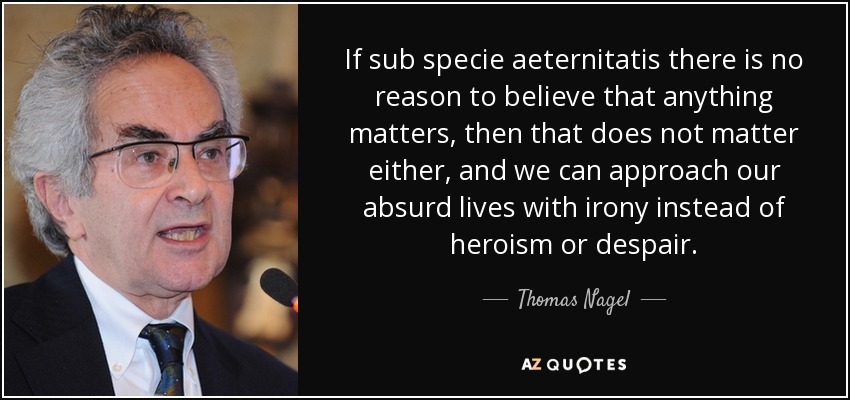
Philosophy: Shots Fired from Thomas Nagel

Image result for thomas nagel

In the West, ever since Fyodor Dostoevsky wrote Notes from the Underground, there have been philosophical counterarguments and challenges to Existentialism, some of which fall under determinism in the debate against free will (the latter of which Existentialist thinkers side with), but they tend to be insufficient because, for how strict and technical they are in interpreting scientific laws and rules, they still have to acknowledge the prevalence of a mystery or higher justification behind determinism.

One of the few Western philosophers that I think has successfully, for a lack of better words, "proved"  the fallacies of Absurdism and to a lesser extent, Existentialism, is Thomas Nagel, whose main interests are the philosophy of the mind, consciousness, politics, and ethics. In his essay The Absurd, he questions why life may feel absurd along with where the theory of absurdity emerges.

Firstly, Nagel fires a shot at the assumption that life is meaningless because none of our actions nor those of past and future generations have any meaning nor will matter in millions of years. He goes along with the idea that we are indeed "tiny specks in the infinite vastness of the universe; mere instants even on a geological time scale," (717) yet refutes the claim that any of this makes life absurd or heavy. Instead, Nagel reasons that existence and life is meaningful without any need for reductionist theories.
...life does not consist of a sequence of activities each of which has as its purpose some later member of the sequence. Chains of justification come repeatedly to an end within life, and whether the process as a whole can be justified has no bearing on the finality of these end-points. No further justification is needed to make it reasonable to take aspirin for a headache, attend an exhibit of the work of a painter one admires, or stop a child from putting his hand on a hot stove. No larger context or further purpose is needed to prevent these acts from being pointless. (717)
In other words, Camus has misrepresented the process of justification as a mere retreat from death and absolute ends. But that is not to say that Nagel thinks that logic and rationales go above everything else; he seems to agree with Camus that existence itself is overwhelmingly vast and thus impossible to fully express, it is just that Existential philosophies tend to move in a rather vacuous direction to compensate with said vastness.

Later on in the essay, Nagel reviews Myth of Sisyphus. As we all know, Camus's essay advocates for Sisyphus, the proletariat of Greek mythology and a tragic hero, to defy the gods and to defy the supposed authority in our lives. This, Camus thought, was the only way to salvage our dignity and be true to ourselves. Here is what Nagel has to say:
This seems to me romantic and slightly self-pitying. Our absurdity warrants neither that much distress nor that much defiance. At the risk of falling into romanticism by a different route, I would argue that absurdity is one of the most human things about us: a manifestation of our most advanced- and interesting characteristics. Like skepticism in epistemology, it is possible only because we possess a certain kind of insight-the capacity to transcend ourselves in thought. (726-727)
He wraps up his essay concluding that it is irony, not despair or heroism, that constitutes Absurdity. I would elaborate further, but the essay is better read than paraphrased. I'm just a student of literature, not of philosophy, after all. Below is a link to The Absurd:

https://philosophy.as.uky.edu/sites/default/files/The%20Absurd%20-%20Thomas%20Nagel.pdf

Wednesday, October 5, 2016

Oh, The Irony...

From the beginning of the book, it is easy to pick up on Meursault's lack of emotion. Throughout various parts of the book, he is shown to be perfectly comfortable with the abuse that he witnesses. At one point, he mentions how his neighbor, Salamano, beats his dog on a regular basis. Directly following the explanation of this horrible fact, Meursault says, "[Raymond] asked me didn't I think it was disgusting and I said no]" (28).

This is where the irony starts. Raymond, another neighbor of Meursault's, is utterly disgusted at the behaviors that Salamano demonstrates towards his dog when he, himself, is known to beat his own mistress. It is as though he recognizes the pain that his neighbor's dog is experiencing more than his human lover. Raymond brings his own set of problems to the table. He asks Meursault to be "pals" and then goes on to tell him that he needs help punishing his mistress emotionally. At this point, Raymond has already told Meursault about how he beats his mistress, but Meursault does not seem to be bothered by it. Raymond decides that the way he will be able to punish his mistress to the extent that she deserves is by writing a letter. Meursault continues to surprise us when he says, "But Raymond told me he didn't think he could write the kind of letter it would take and that he'd thought of asking me to write it for him. Since I didn't say anything, he asked if I'd mind doing it right then and I said no" (32).

Emotionless Meursault strikes again! He not only has no problem with animal abuse, but domestic abuse as well! You would think that he would never feel anything for another human being, right? Wrong! Here is where more irony in the story is brought into play. When Meursault is talking to Raymond about killing the Arabs at the beach later on in Part 1, he says, "'But if he doesn't draw his knife, you can't shoot'" (56). It is almost as though Meursault wants the Arabs to be treated fairly, even though he doesn't know them.

Meursault is extremely hard to read at this point in The Stranger. He has shown that he is able to turn a blind eye to horrors that surround his daily life and affect him directly, but doesn't want to hurt the Arabs if they mean no harm. Is it because they are men? Does he not notice the domestic and animal abuse that he is around on a regular basis because they have become so routine to him? At this point, we really don't know why Meursalt acts the way he does. He continues to surprise us with each page turn.

Monday, October 3, 2016

Raymond and Meursault: Friendship of Foils

In my opinion, Meursault's oddest choice in the first half of the first part of Albert Camus's The Stranger was to befriend Raymond Sintès and assist him in his domestic issues. Despite both Meursault and Sintès being social pariahs, they are fundamentally distinct from each other, which Camus emphasizes through effective character development and light-handed symbolism.

From first glance, Raymond and Meursault contrast in more ways than one. While Meursault is a chronic pacifist and tends to avoid confrontation, as shown by his reluctance to confront his boss about his mother's funeral, Raymond is shown to be arrogant and spontaneous in his actions, such as when he punched the man at the train station for insulting his manliness. While both men appear to both have no sense of sympathy, Meursault's lack of sympathy seems to stem more from apathy such as an inability to connect with his dead mother, while Raymond's draws parallel to hubris, shown in his treatment of his girlfriend. This juxtaposition is equally present in many of the minor character traits of the two, with Raymond described as being rough and boxer-like and Meursault being portrayed as a lowly businessman with few edges. Such distinctions can also be drawn from the foods they enjoy, with Meursault drinking coffee with cream, which can be extended to state that Meursault dulls his own senses of emotion to the point of making himself characteristically bland. Likewise, Raymond is shown to have a fondness for blood sausage and (presumably red) wine, which are known to have exceeding strong flavors, that reflects his brash, strongman-like attitude.

Altogether, Meursault's decision to befriend Raymond was one of his oddest choices so far, but has the potential to become one of his greatest assets. Being perfect foils to each other, Raymond and Meursault can learn from each other and develop into more well rounded people.